
Like most, I have a Virgin Active gym membership. Unlike most, I actually try to go almost every day. I have been specifically good at it this year, having made it almost every Monday to Friday since the start of the year, and the results show. I feel phenomenal. I am not the person who bought a membership in January and stopped turning up by March. I turn up. I love the work. I love the booming techno in my ears as I try to squeeze out one more rep. I love the feel of a set that costs you something, the modest satisfaction of adding two and a half kilograms to a lift that refused to move six weeks ago. But I must admit, I do not love the gym. Even after the much-debated and much-complained-about upgrade that seems to have added an additional 30% to all our membership fees. But that is beside the point. The point is that the distinction between loving to work out and loving the gym matters more than it looks.
The gym is a building with equipment in it. Fitness is what happens to a body when a person who knows what they are doing does the right work at the right intensity for long enough to matter. Those are not the same thing. They are not even adjacent things. Most of the people in Virgin Active on any given morning are doing some version of the wrong exercise with the wrong form for the wrong goal. I have probably been one of them for entire months of my life. I have certainly been one of them for entire weeks.
The gym is not fitness. The gym is the room where fitness sometimes happens when the right person is in the room with you. The commercial genius of the category is that it gets you to pay a monthly fee for access to the room and then lets you believe the room is the product. It is not. The product is never the room.
I bring this up because I have spent the better part of two decades building what is, in retrospect, the same business on the other side of the wall.
The inside view
I founded one of the largest learning platforms on the African continent. SynrgiseLearn serves higher education institutions, training companies, corporates and enterprise clients across the continent. It carries compliance, onboarding, accredited qualifications, and ongoing capability development. It is a real platform with real customers and real engineering discipline behind it. We have made it demonstrably better over the years. We refined the UX. We built proper gamification that rewards meaningful behaviour and not participation theatre. We aligned content to role, to competency, to career frame. We integrated with HR systems and with payroll and with the things enterprises actually run on. The product is good. The team is good. The category is broken.
I am going to say that clearly because it is the key point I am going to make. The Learning Management System category is broken in the same way the gym membership category is broken. We have been improving the equipment. We have been adding screens to the treadmills. We have been organising the weight racks more sensibly. We have not been, and could not have been, producing fitness. Because the thing that produces fitness is not in the room with the learner. It has never been in the room. We sold the room and called it the product.
An LMS is a library with a registrar attached. It holds the content. It records who looked at the content. It issues a certificate when the looking is completed and the assessment is passed. This is a useful function. It is an operational function. It is a compliance function. It is not a learning function. We have spent thirty years confusing those categories on purpose because the operational one is the one that scales and bills and closes.
I am not throwing stones from outside. I am the guy who sold the room.
The two sigma problem
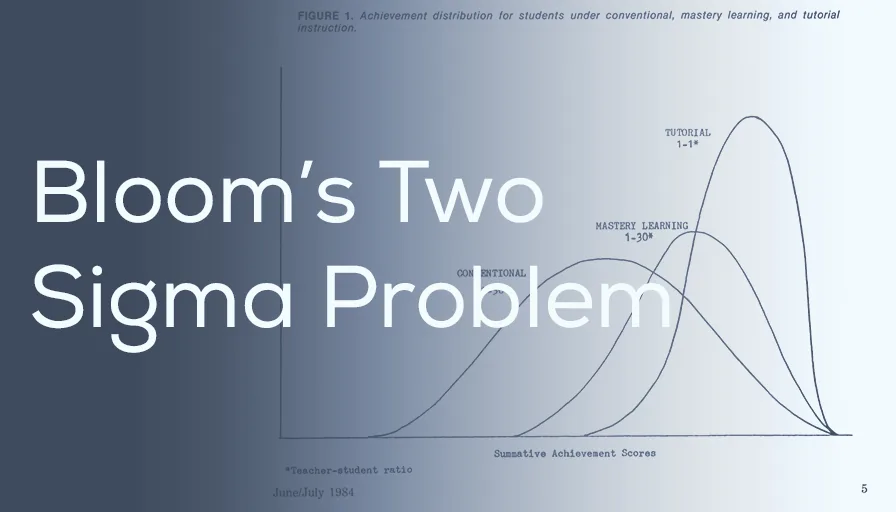
In 1984 an educational psychologist named Benjamin Bloom published a paper that has haunted the field ever since. It is called The 2 Sigma Problem. Bloom showed that students taught one-on-one by a competent tutor, using mastery-based methods, outperformed students taught in a conventional classroom by two full standard deviations.
Two standard deviations is not a marginal improvement. Two standard deviations is the gap between the average and the ninety-eighth percentile. It is the difference between a pass and a distinction. It is the single largest educational intervention ever measured and it has been known for forty years.
Bloom called it a problem because one-on-one tutoring does not scale. You cannot give every working adult in South Africa their own Aristotle. You cannot give every junior underwriter their own personal coach. You can barely afford it for your children. And it is the oldest form of educational inequality that exists. The rich get tutors. Everyone else gets the room.
So the category built the room. The Learning Management System is the best room the industry could build under the assumption that tutors do not scale. We built shelves and sat the books on them. We built search. We built recommendations. We built reporting that tells a line manager who has completed what and who has not. We built all of this in good faith. None of it addresses what Bloom measured. None of it could. A student does not close a two-sigma gap by having better search. A student closes a two-sigma gap because a human is paying attention to that specific student, remembers what happened yesterday, notices what is happening today, and adjusts what happens tomorrow.
For forty years that was impossible to deliver at scale. So we pretended the thing we could deliver was the thing that mattered. And that belief has transcended the rise of AI. Everyone is now just doubling down on the room… well, almost everyone.
Adding AI, or how the industry is lying to itself right now

Every LMS vendor in the market currently has an AI story. Docebo has Shape. Cornerstone has a skills graph and a generative authoring suite. Sana has positioned itself as AI-native and is shipping what remains, underneath the new interface, a content platform with a better search bar on top. 360Learning, Absorb, LearnUpon, Thought Industries, Degreed, SAP SuccessFactors Learning, Workday Learning. Every press release. Every quarterly update. Every keynote. AI, AI, AI.
Read the feature lists carefully. Strip away the language. You will find that the industry is doing exactly two things with AI and only two things.
The first is mapping content to users more cleverly. The search bar got smarter. Recommendations got more personal. An employee types a question in natural language and the system returns a course rather than a list of courses. This is genuinely better than what came before. It is also not what Bloom was measuring. The student who scored two deviations higher than her classmates did not get there because now she can chat to her textbook.
The second is generative authoring. An administrator uploads a policy document and the system produces a course from it. Slides. A quiz. A scenario. A certificate at the end. Faster content production. Lower cost per module. More courses in the catalogue.
This is where I want to be careful because the failure mode here is serious and almost nobody in the industry is being honest about it.
The slop problem
Generative AI is intoxicating at the surface. Everyone has felt it. The Nano Banana image that lands in the group chat. The seven second video that looks like it cost a studio a week. The slide that was produced in four seconds and looks, at a distance, like it took a morning. The feeling of the first successful prompt is a small drug. I have taken it. You have taken it. Anyone reading this has taken it.
Then you try to do real work with these tools and the second reality arrives.
The tools are deceptively shallow. Using them well requires the expertise they appear to replace. A graphic designer with a trained eye produces extraordinary images from an image model because the designer knows what good looks like and can iterate toward it. A non-designer with the same tool produces a busy, off-brand, six-fingered, nearly right, fundamentally wrong image that will be used anyway because it came out of the machine and the machine is magic. We have all seen these images. We are now swimming in them. The internet has begun to take on the aesthetic of a stock photo library that has been lightly poisoned.
Instructional design is exactly the same problem and almost nobody is discussing it.
Building a learning experience that actually develops capability in an adult human is a craft. It is a serious craft with a hundred years of research behind it. Cognitive load theory. Spaced repetition. Bloom's taxonomy, which is the same Bloom. Scaffolding. Formative assessment. The difference between recognition and recall. The difference between knowing about a thing and being able to do the thing. An instructional designer with fifteen years of experience knows, when she sees a draft module, which parts will land and which parts will wash straight through the learner without leaving a mark. She knows it the way the designer knows which image is wrong.
A marketing manager using a generative authoring tool produces content that looks like a course. It has modules. It has quizzes. It has a completion bar. It has a certificate at the end. It does not teach anybody anything, because the design choices underneath it were not made by a person who understands how adults learn. The learner completes it. The system records the completion. The manager reports the completion. The audit passes. No capability has been built. The only thing that has been built is the illusion of capability, produced at industrial scale, now with an audit trail.
The internet is already drowning in AI slop. Corporate learning is about to pour a decade of its own contribution into the river. Every LMS with a bolted-on authoring feature is, whether the vendor will admit it or not, a slop factory. It will produce more content, faster, at lower cost, with worse outcomes, and the quarterly report will look excellent. Completion rates will hold or rise. The organisation will feel, from the spreadsheets, as though it is developing its people. The people will feel, from the inside, as though nothing much has changed. Because nothing much will have changed.
This is not an AI problem. This is a category problem that AI has made worse. The LMS was already not the thing. Bolting a generation engine onto it does not make it the thing. It just makes the not-the-thing arrive faster and in greater volume.
What the thing actually is
My eldest son has struggled with computer IT at school. Which is, obviously, unexpected in the household he grew up in, where I am a CTO and there are screens of varying intimidation in every room. He has access to the content. He has access to me. He has access to every course on the internet. None of those things moved him.
What moved him was us sitting down together. Small sessions. Specific problems. Activities he could relate to, built around things he cared about, calibrated exactly to what he already understood and what he was reaching for. I would notice when he drifted. I would adjust. I would remember, next time, where we had left off and what had tripped him up and what had clicked. I did what any half-decent tutor does. And the result. He bloomed (see what I did there). Rapidly. More than two deviations, in fact, which is the only time in my life I have been able to measure the gap Bloom described and watch a human being cross it.
There was nothing special about what I did. It was the oldest educational technology that exists. One person who knew the subject, one person learning it, and the continuous act of attention between them. It is what Aristotle did for Alexander. It is what a good piano teacher does for a child. It is what a competent personal trainer does for a body. It is what the wealthy have always purchased for their children and it is what every corporate LMS ever built has failed to reproduce.
The reason it failed to reproduce was economic, not conceptual. We always knew what the thing was. We could not afford to deliver it. So we built a bigger and better room.
But we can afford to deliver it now.
That is the whole point of the last two years. That is what has changed. Not the content pipeline. Not the search bar. Not the authoring speed. What has changed is that the one resource education has always rationed is no longer rationed. Attention. Patient, specific, remembered, repeated attention, at the scale of every employee in an organisation, in their own voice, on their own plan, across their own development arc, with a memory that persists between Tuesdays.
That is not an LMS feature. It was never going to be an LMS feature. It is a different shape of thing.
It's Coming Faster than you Think
We have been building that different shape of thing for the past 18 months. I am not going to write about it here. I am not even going to tell you what we call it. All I will say is that it is coming, we are the ones to bring it, and it will obliterate my category one room at a time.
The hard truth is that the LMS was always the wrong primitive. We suspected this for thirty years and sold it anyway because it was the best we could do. The honest version of the current moment is not that AI has made LMSs better. The honest version is that AI has made LMSs obsolete, and most of the industry is still selling the room with a generation engine bolted to the wall, hoping nobody notices that the thing next to the room is quietly walking away with the actual job.
The hadedas are starting up outside. I am going to the gym.
I will find the room where fitness sometimes happens when the right person is in it with me. I have made my peace with that. The gym is honest about what it is. It says equipment on the door and equipment is what it sells. It does not claim to be a coach. It does not charge you for a coach and then deliver a room.
The learning industry has been running that trick for thirty years. It has built a multi-billion-dollar global category on it. It stops working the moment somebody builds the actual coach.
We have.