
I used to wake up early. Now I wake up before the country does. There is a difference, and it happened so gradually that I did not notice it until I was sitting in the dark wondering when this started. In South Africa, the unofficial alarm clock is the hadeda ibis, a large and profoundly opinionated bird that launches itself from its roost tree at five every morning and screams its own name at the neighbourhood with the energy of someone who has been personally wronged by sunrise. For twenty years, the hadedas and I had an understanding. They would start. I would not be far behind. I am now two hours ahead of the hadedas.
That gap, two hours of dark and quiet that should feel like reclaimed time. And in a way it does. Except that I am not sitting in it. I am deploying into it. By the time five o'clock rolls around, I have already shipped something. A full deployment architecture across three cloud providers. Not a sketch. Not a plan to make a plan. The actual architecture, documented, with failover logic and cost projections and environment configs. Six months ago that was a two-week project. Today it sat alongside a compliance document, a restructured fee model, and a strategy session I probably should not have been alert enough for but somehow was.
The morning that used to be preparation has become operation. The stillness I woke into has been filled, efficiently and enthusiastically, by more work than I used to do before lunch.
You would think that kind of compression would leave time. Four days of work packed into one. Simple arithmetic. Three days left over. You would be wrong.
What actually happened is that I looked at the remaining capacity and thought, well, if I can do that before breakfast, then I should probably also tackle the thing I had parked for next quarter. And the thing after that. And the integration work I had mentally filed under "when things calm down," which is a place where things go to live forever because things do not calm down. They especially do not calm down when you have just demonstrated to yourself that you can do more.
So I did more. And then I woke up earlier to do more again. And the day did not end sooner to compensate. It stretched at both ends, and most of what filled it was genuinely good work, and that is what makes this so difficult to examine clearly.
This is not a complaint. It is a data point. And it is the same data point that a nineteenth-century economist named William Stanley Jevons recorded about coal, which tells me it is probably not about me specifically.
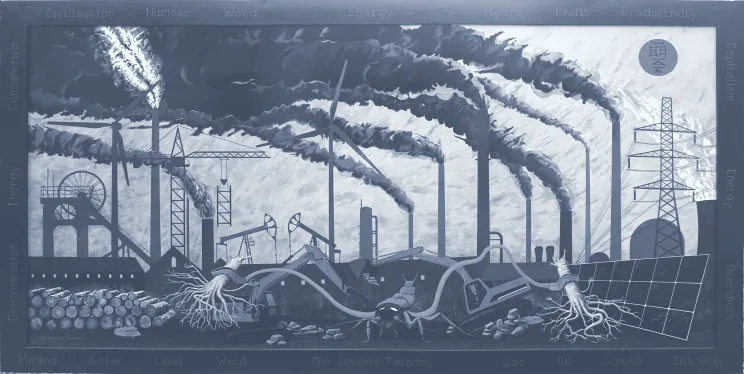
Thank You Jevons
William Stanley Jevons was a British economist with a problem that nobody wanted to hear about. It was 1865. The industrial world was running on coal and getting better at it every year. Steam engines were becoming more efficient, burning less coal per unit of output, and the reasonable conclusion that every engineer and politician drew was obvious. More efficient engines would mean less coal consumed. The supply would last longer. The future was bright and increasingly fuel-efficient.
Jevons said no. He said the opposite would happen, and he was right, and almost nobody thanked him for it.
His argument was elegant and annoying. When you make a resource cheaper to use, you do not use less of it. You find more reasons to use it. An efficient steam engine does not just replace an inefficient steam engine. It makes steam power viable in factories, mills, ships, and railways that could never have justified the cost before. The per-unit consumption drops. The total consumption explodes. You have not saved coal. You have invented a thousand new ways to burn it.
Coal consumption in Britain did not decline after Jevons published. It accelerated. The more efficiently they could burn it, the more applications they found for burning it. The efficiency gain was real. The savings were imaginary. I think about Jevons a lot at half past three in the morning.
AI has not made me faster at the things I was already doing. That is the wrong framing, and I fell for it initially, and I suspect most people do. What AI has actually done is lower the cost of competence across a range of tasks that used to carry a real time-price. Writing a compliance framework. Modelling a fee structure across multiple client tiers. Designing a multi-region deployment with sensible failover logic. Each of these used to be expensive enough in hours that they rationed themselves. You would do them when they were critical and defer them when they were merely important. That rationing is gone.
The architecture I built today is the perfect Jevons example, and I did not see it clearly until I started writing this. Six months ago, I would not have attempted a three-provider deployment at this stage. Not because I did not know it was the right architecture. Because the time cost of designing, documenting, and validating it was prohibitive against everything else that needed doing. I would have gone single-provider, revisited the decision later, and filed the multi-cloud version under "when things calm down." That place again.
AI made the cost low enough that the project became feasible. So I did it. And because I did it, I saw three other things that were now also feasible. And because those were feasible, I started them. The result is not that I did the same work faster. The result is that I attempted work I would never have started.
Jevons was writing about coal. He was actually writing about us. The resource changes. The pattern does not.
If you think this is a story about AI, I need to disappoint you. It is a story about what humans do with efficiency gains, and we have been running the same experiment for decades.

The Dawn of the Pocket Office
The BlackBerry promised that you could stay connected when you needed to, even away from the office. Check an urgent email from the airport. Respond to something critical from the dinner table. The key word was "urgent." The key concept was "when you need to." What actually happened is that the office followed you home, and then on holiday, and then to your daughter's school play, and it never left. The ceiling of availability, which used to be "when you are physically at your desk," became the floor. Being unreachable went from being the default state of a person who had left the building to being a choice you had to actively justify. Nobody decided this. Nobody sent a memo. The tool enabled it, and the culture absorbed it, and within five years the expectation had fully recalibrated.
Email did something similar but in volume. Before email, written business correspondence was slow and expensive enough to impose its own discipline. You wrote a letter when a letter was warranted. You thought about what it needed to say, because the cost of sending it, in time and effort and actual postage, meant you were not going to send twelve of them before lunch. Email made the cost of sending essentially zero. The volume responded accordingly. We solved the speed problem entirely and created the volume problem from nothing. A full in-tray had natural limits. It was physically bounded. A full inbox has no limits at all, and it regenerates overnight like something from a horror film.
Then the pandemic taught us that meetings did not require travel. This was genuinely useful. It saved real time and real money and real carbon emissions. It was an unambiguous efficiency gain. Within six months, calendars were stacked back-to-back-to-back in ways that no physical commute would have permitted. The travel time between meetings, which had always felt like dead time, turned out to have been doing something important. It was thinking time. Transition time. The fifteen minutes between things where your brain could shift gears. We colonised that time with more meetings, because the technology allowed it, and then wondered why everyone felt like they were drowning in a way they had not been drowning when they were spending two hours a day in a car.
Each of these tools was genuinely useful. Each of them genuinely improved something. None of them gave anyone more time. They changed what a normal day looked like, and the new normal quietly swallowed the surplus.
We did not keep the time. We filled it.
The speed you are running at right now is just running. It does not feel fast. And by the way, It's only Tuesday.
There is a thing that psychologists study, sometimes under the term hedonic adaptation, which describes the human talent for normalising new conditions with alarming speed. Win the lottery and within a year your baseline happiness has returned roughly to where it was. Move to a bigger house and within six months it is just your house. The upgrade becomes the default, and the default does not feel like an upgrade. It feels like normal.
This works in every direction, including the one we are talking about.
The first time I produced a complete compliance framework in a single day, I felt the gap. I felt the absurdity of it. I sat back and thought, genuinely, that I had found a cheat code. Something that used to take a focused week had taken a focused day. The remaining four days stretched ahead of me like a gift.
That was about eight months ago. Today, if a compliance framework takes me two days, something has gone wrong. The gift is gone. The new speed is just speed. It is the baseline against which I measure whether I am having a productive day or a slow one, and it took less than a year for that recalibration to complete itself.
Nobody did this to me. No manager set a new target. No client moved a deadline. I did it to myself, incrementally, without a single conscious decision to raise the bar. The bar just rose because the evidence kept suggesting it should. And it is not just the speed. It is the radius...
I am currently building across three separate ventures. Not advising on. Not thinking about. Building. Infrastructure code, compliance documentation, investor materials, platform architecture, commercial strategy, content, integrations. Eighteen months ago, the idea of running all of these simultaneously would have been absurd. Not because I lacked the ambition. Because the hours were physically insufficient for the output required.
The hours have not changed. The output per hour has. And instead of pocketing the difference, I expanded into it. Projects I would have filed under "someday" are now in active development. The backlog that AI was supposed to clear has been replaced by a larger, more ambitious backlog. I have not caught up. I have raised the bar for what catching up means.
The treadmill does not speed up on you. You speed it up yourself, one small recalibration at a time, and because each increment is small, you do not notice the cumulative effect until you look up and wonder when the day started stretching at both ends.
The question is whether this is a flaw or a feature. It might be both. It might depend on whether you chose it.
The AI did not make you work more. That part is important to say clearly. The AI gave you leverage. You decided what to do with it.
I use that word deliberately, and I have saved it for here, because leverage is the honest word for what is happening and it carries the right weight. A lever does not care what you use it for. It multiplies force. It does not supply direction.
The distinction that matters, the one I keep circling back to at half past three in the morning, is between conscious expansion and the other kind.
Unconscious expansion is what Jevons described. The cost drops. The scope grows. The hours extend. The ambition inflates. And you notice all of this after the fact, if at all. It happens in the gap between what you could do and what you now find yourself doing, and the gap closes so gradually that there is no moment where you can point and say "there, that is where I made a choice." Because you did not make a choice. You made a series of small, individually reasonable responses to changed conditions, and the aggregate of those responses is a life that looks quite different from the one you had planned.
Conscious expansion looks identical from the outside. You are still at the desk. You are still building. The output is still high and the hours are still long. But somewhere in the process there was a moment of actual decision. A point where you looked at the leverage available and decided, deliberately, what you wanted to build with it. Not what you could build. What you wanted to build.
I am being honest when I say that I do not always know which one I am doing. Some of the expansion was chosen. I looked at what AI made feasible and I decided to build things I had wanted to build for years. That was a real choice, made with open eyes, and I do not regret it.
Some of it was just gravity. Capacity existed. I filled it. Not because I decided to, but because that is what capacity does when you are the kind of person who builds things. It gets filled. And the filling feels productive, because it is productive, and that is what makes it so difficult to examine clearly. The output is real. The question is whether the direction was chosen.
Here is the question I suspect you have not asked yourself recently, because I had not asked it either until I started writing this at an hour that suggests I should probably ask it more often.
When did you last decide what a full day's work should look like, rather than just filling it to the edges?
The tools do not ask this question. They enable. They do not curate. They give you the lever and they step back, and if you are the kind of person who reads articles about AI and productivity at any hour of the morning, you are almost certainly the kind of person who picks up every lever available and finds something to move with it.
Jevons' paradox is not a trap. It is a default setting. Defaults can be changed, but only if you notice them, and the entire mechanism of this particular default is designed to avoid being noticed. It feels like progress. It feels like ambition. It feels like building.
Sometimes it is all of those things. Sometimes it is just the coal burning faster because the engine got more efficient.
You are almost certainly doing more than you were a year ago. Some of that is good. Things you wanted to build are now buildable, and you are building them, and that is precisely what leverage is for.
Some of it is just Jevons. Efficiency created appetite. Appetite filled the space. The space is now the new normal. And the new normal feels like normal, because that is what new normals do.
The only question worth asking is which is which.
The leverage is real. What you do with it is the only part that is actually up to you.
It is still half past three. Or it will be again tomorrow. And the morning after that.
The laptop will be open. Something will be getting built. The day will stretch longer than it used to in both directions, and most of what fills it will be good work that I chose, or that I think I chose, or that chose me so gently I did not notice the difference.
I have not solved this. I am not going to pretend I have. But I have started asking the question before I open the laptop instead of after I close it, and I have started noticing when the answer is "because I can" rather than "because I decided to."
That is not wisdom. It is just a slower finger on the lever. Some days it is enough.
Most days I pull it anyway.