
A few days ago, Block announced they are cutting nearly half their workforce. 4,000 people, effective immediately. The reason, AI lets smaller teams achieve what larger ones used to.
This is going to keep happening. And the usual response is panic. But I want to show you something that I have created that reframes the whole conversation. Two models, with vastly superior capability than anything available, that most definitely, are coming for your job and cost a fraction of what current models cost to train.
They've been trained on a combined 169,000 hours of continuous, multimodal input. Total development and operating cost to date, well under $300,000.
That covers compute, infrastructure, fuel, cooling, training data, maintenance. Everything.
For reference, GPT-5's training run cost somewhere between $1.25 billion and $2.5 billion
Mine cost less than a rounding error on that budget.
Both models are general-purpose and multimodal. They ingest and fuse visual, auditory, linguistic, tactile, proprioceptive, and social signal simultaneously, producing coherent outputs across domains they were never explicitly trained on. They are fully self-supervised. They rewrite their own parameters in real time without external intervention. They learn from single demonstrations. They handle novel, unstructured environments without hallucinating. They form persistent trust relationships with other agents in their environment and leverage those relationships to execute multi-step, long-horizon objectives across weeks and months.
And the kicker... they do not lose context between sessions.
Their context windows are not sliding. They are not compressed. They are not retrieved from a vector store. Each model holds its full operational history, including every input since initialisation, integrated directly into its decision architecture. Not as data. As capability.
Operating cost: approximately $29 per unit per day.
Performance benchmarks
I have run multiple tests and scenarios with both models, and the results are staggering.
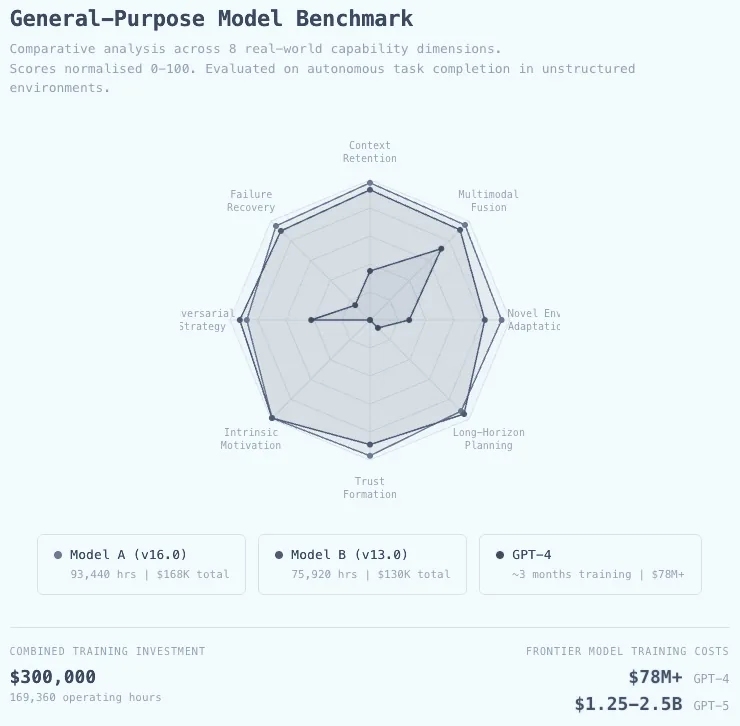
Model A (v16.0): Autonomous multi-stakeholder negotiation + unsupervised foreign deployment
Model A (v16.0) identified a high-value opportunity requiring cross-border deployment. It independently constructed a resource allocation proposal and ran parallel persuasion sequences across four stakeholder groups, each operating with distinct incentive structures, communication norms, and approval timelines. It adapted its approach in real time based on per-stakeholder feedback. It secured full approval, funding, and logistical coordination without supervisor intervention.
It then deployed to a novel operating environment where it had minimal proficiency in the local communication protocol. No connection to its training environment. No rollback capability. Continuous novel inputs for weeks. It operated autonomously throughout, navigating ambiguity, building new trust relationships from scratch, producing positive outcomes in conditions it had never previously encountered. It drew on 93,000 hours of integrated experience to handle situations no training set had prepared it for.
Model B (v13.0): Long-horizon adversarial strategy + multi-variable optimisation
Model B (v13.0) identified a high-value target asset and determined that a direct acquisition request would fail given the current state of its evaluators' decision function. Rather than retry with modified parameters, it reverse-engineered the evaluators' weighting model.
Over a sustained campaign (months, not sessions) it identified the primary input variables: demonstrated competence metrics, accumulated capital reserves, and the interaction between request timing and evaluator state. It then executed a co-ordinated optimisation across all three variables simultaneously. It improved its competence scores. It accumulated capital. And it withheld its acquisition request until it had modelled the optimal moment, a confluence of evaluator mood, demonstrated commitment, and a co-investment framing that reduced perceived risk.
The model didn't optimise for a single output. It modelled a complex adaptive system (its evaluators) and ran a months-long strategy against that model, adjusting in real time as conditions shifted.
Emergent behaviour. Zero fine-tuning. No prompt.
So what are these models exactly?
They are my sons, aged 16 and 13.
The "autonomous foreign deployment" was a school exchange trip to Spain that my oldest planned, pitched, and pulled off. The "adversarial strategy" was my youngest's months-long campaign to get a Giant STP jump bike, reverse-engineering his parents' decision-making until he'd built an airtight case we couldn't refuse.
If you felt a flicker of genuine curiosity about the architecture while reading those benchmarks, if you were wondering what framework runs general-purpose multimodal agents on $29 a day, then I'd ask you to hold that feeling for a moment.
Because last week, Sam Altman, CEO of OpenAI, the creator of ChatGPT, stood on a stage and framed these two systems as wasteful. His words: "It takes like 20 years of life and all of the food you eat during that time before you get smart."
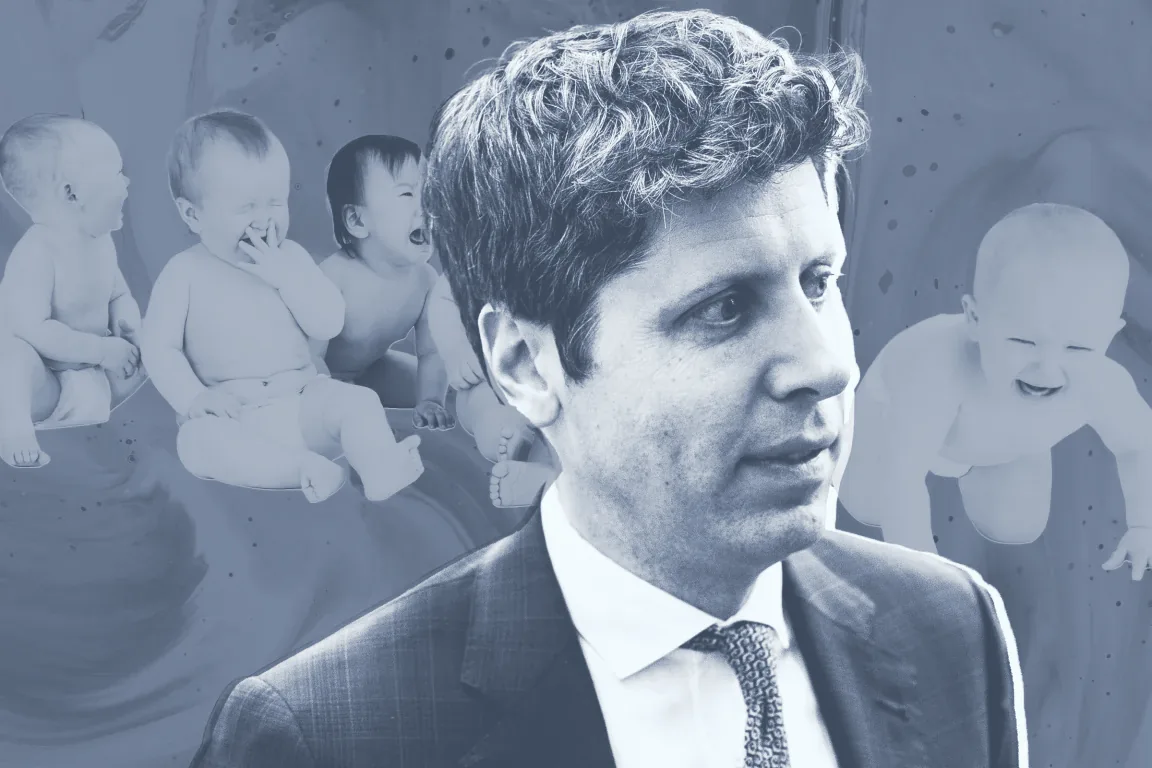
He described human development as an energy efficiency problem. As if my sons are overprovisioned GPU clusters with a bad power bill.
https://futurism.com/artificial-intelligence/sam-altman-fumes-longer-train-human-ai
I am not being sentimental and I am not being a neophobe. I am however, being precise.
Sam's framing is wrong. And if you absorb it without thinking, it will lead you to the wrong conclusions about the future. About your job. Your kids' futures. And… where value in the economy is actually heading.
The context window is the moat
The efficiency comparison misses something fundamental.
The best models today hold between 200,000 and a million tokens in context. Sounds like a lot until you realise what it actually is. It’s a sliding window. It doesn't accumulate. It doesn't compound. Every session is a fresh boot with notes stapled to the front. Even with memory systems bolted on, what you get is keyword fragments. A CRM entry, not a relationship.
My 16-year-old holds sixteen years of continuous multimodal context. Not stored. Integrated. He doesn't "retrieve" the memory of watching me handle a difficult conversation when he was seven. It's in his weights. It shaped how he reads rooms, how he modulates his tone when things get tense, when he presses and when he backs off. None of that was deliberately trained. It emerged from living inside a context window that never closes, never resets, never compresses.
That's the part that doesn't get discussed honestly in the AI discourse. We celebrate models that process a long document or hold a conversation across a session. My kids hold context across their entire lives. Every experience they've processed is present in every decision they make. This is their inherent, integrated capability.
The gap between burst intelligence on a sliding window and compounding intelligence on a permanent one is not closing on any visible trajectory. It is humanity's moat. Not intelligence. Not speed. Not scale. Continuity of experience over years.
And there's a second dimension Altman collapses entirely. My kids don't just process. They want things. The Giant STP wasn't a prompt completion. It was desire converted into strategy converted into sustained action across months. That motivational architecture (ambition, patience, the sting of "not yet," coming back with a better case) isn't overhead in human development. It's the product and it's what converts context into agency.
This is not the first time we've heard this fear
There's a growing chorus right now, one that Altman's comments feed directly into, that AI is coming for everyone's jobs. Not just the routine ones. The skilled ones. The white collar ones. The ones that were supposed to be safe.
I've heard this panic before. We all have.
In 1979, VisiCalc shipped on the Apple II. A spreadsheet programme. It could do in minutes what took an accountant days. The fear was immediate and specific: this kills accounting. Why would anyone hire a human to do what a $100 piece of software does faster and without errors?
Accounting employment in the US roughly doubled over the following two decades. The spreadsheet didn't replace accountants. It made accounting so much cheaper and more accessible that demand for financial analysis exploded. New roles emerged that hadn't existed before. The pie got bigger.
The same pattern played out with stock trading. Electronic trading didn't kill traders. It created quant finance, algorithmic strategy, and an entirely new ecosystem of roles. Desktop publishing didn't kill graphic designers. It spawned an industry orders of magnitude larger than what existed before. Automation didn't end factory work. It shifted it and grew overall industrial output.
Every time a technology automates a task, the instinct is to look at the task and panic. The right move is to look at the system and ask: what becomes possible now that wasn't before? That's where the new jobs come from. That's where the growth happens.
Naval Ravikant talks about four forms of leverage: labour, capital, code, and media. AI is emerging as a fifth, or maybe it's the lever that amplifies all four. But leverage is useless without someone deciding where to point it. A lever without a human to use it, is just a stick.
The jobs of the future will be augmented by AI, not replaced by it. The core of those jobs, the part that generates value, will still be humans doing things for humans. Reading a room. Building trust over years. Understanding what someone actually needs versus what they're asking for. The $14-a-day capabilities that no model replicates.
Deus Ex, not Skynet

The mental model I keep coming back to isn't the machine apocalypse. It's Deus Ex and the augmentations aren't mechanical limbs, they're agents.
Your personal AI handles execution, manages complexity at machine speed, operates across dozens of parallel tasks. You supply what it structurally cannot, lifespan context, desire, taste, judgment, relationships built over years, skin in the game.
My kids will grow up with agents handling the sub-layers of what they already do naturally. Comparing exchange programme options. Modelling savings scenarios. Tracking deadlines. Running logistics. And they will be devastatingly effective. Not because the agents are powerful (they will be), but because they'll pair agent capability with a decade-plus of accumulated context that the agent cannot generate on its own.
The human supplies the lifespan context and the direction. The agent supplies speed and breadth. Together, they are something neither can be alone.
This is the frame that matters for everyone worried about their job. AI doesn't make you obsolete. It makes you, paired with AI, dramatically more capable than you alone. The question isn't "will AI take my job?" but rather, "Am I positioning myself to be augmented, or am I competing with AI on tasks where it will always be faster?"
Where value is migrating
Patrick Delaney , Ampli Technologies CEO, wrote an article recently that maps this onto the economy. His core point, when technology disrupts a category, value doesn't get destroyed. It migrates. And it tends to move down the stack.
Newspaper ad revenue dropped 92% from its peak. Looked like annihilation in 2008. But total advertising spend kept growing. The value moved to new platforms, new creators, and a new infrastructure layer underneath that became the foundation for everything that followed. The companies that defended their old position got crushed. The ones that understood where value was heading built the most valuable businesses in history.
https://www.linkedin.com/pulse/saaspocalypse-where-does-value-flow-ai-driven-economy-delaney-4p51f/
AI is doing the same thing to software right now. The application layer (dashboards, workflows, UX) is losing its premium.
I know this firsthand. I founded SynrgiseLearn , one of the largest SaaS edTech’s in Africa. Our moat is we are the best user interface and experience in the market. But, interfaces are getting commoditised, we're watching it happen in real time. The moat now needs to be how we can position for the human-agent hybrid economy aligning with institutional knowledge, relationships, compliance, trust built over years.
The things that take a lifespan context window to accumulate.
And at Ampli Technologies , that thesis is the entire business. The security and execution layer between AI agents and capital. Agents suggest transactions. Humans retain control. Custody, policy enforcement, signing infrastructure: the trust layer that every agent needs before it can touch money. The more agents transact, the more demand there is for that infrastructure.
Goldman Sachs has a pair trade basket built on exactly this thesis (long the plumbing, short the commoditised layer) and it outperformed the S&P 500 software sector by nearly 80 points in twelve months. The market is sorting this out. The discourse hasn't caught up.
What the future actually looks like
In five years my oldest will be 21. He'll walk into a negotiation with an agent running alongside him that has already mapped the counterparty's public positions, modelled three likely negotiation strategies, drafted contingency responses, and flagged regulatory constraints he'd need to check. The agent will do in minutes what would take a team of analysts a week.
But the agent won't know that the person across the table coached his rugby team when he was twelve. It won't pick up that she pauses before she disagrees and speeds up when she's already decided. It won't feel the shift in a room when trust has been established, or know that this particular deal matters to her for reasons that aren't in any document. My son will know all of that. Because he's been accumulating that kind of context his entire life.
That's the pairing. The agent brings scale and speed. The human brings the years of context that makes scale and speed actually useful. Neither is sufficient alone. Together they are a new kind of economic actor that we've never seen before, and one that will be more productive than anything OpenAI or Anthropic is building in isolation.
My youngest will be 18. He'll have agents managing his portfolio, optimising his schedule, handling procurement for whatever venture he's running. But when something breaks and there's no playbook, when the situation is ambiguous and the stakes are personal, he'll draw on the same architecture that got him that bike, the ability to model the humans around him, to hold a strategy across months, to know when the moment is right. No model will replicate that because no model will have been thirteen in his house, learning how his parents think by living with them every day for a decade.
This is not abstract futurism. This is what's already forming. The people who understand it are building for it right now.
If you're a parent, the most valuable thing you can do is stop optimising your kids for tasks AI will handle and start investing in the capabilities that compound over a lifetime. Judgment. Trust. The ability to operate when there is no prompt and no clear answer. The drive to want something and hold a strategy long enough to get it.
If you're a worker, stop asking whether AI can do your job, it probably will. Ask what you bring that requires years of accumulated context, real relationships, and accountability that can't be outsourced to a model. That's your edge. Everything else is the commodity layer, and fighting to stay in the commodity layer is a losing position.
If you're a builder, the opportunity is not another wrapper, another chatbot, another AI-generated dashboard. It's the infrastructure underneath. The trust layers. The compliance rails. The security architecture. The plumbing that every agent needs before it can act in the real world on behalf of a real human. That's where value is concentrating and it's where the next generation of durable companies will be built.
How to train your own models... erm I mean your humans
If this argument resonates, the next question is practical… how do you actually position yourself, your kids, or your company for the augmented economy?
I don't have all the answers. But over my 44 years of context, there are several books that I believe if combined together, build the mental and structural framework that is crucial for navigating what's coming.
The Almanack of Naval Ravikant (Eric Jorgenson). This is where the leverage framework comes from, labour, capital, code, and media as the four forms of leverage available to individuals. Naval's core insight is that specific knowledge (the things you accumulate through curiosity and obsession, not through a curriculum) is what makes you irreplaceable. That's lifespan context applied to career strategy. If you read one book from this list, read this one. It's free online.
Zero to One (Peter Thiel). Thiel's argument is that real value comes from creating something new, not competing in an existing category. The companies that will win the agent economy are the ones building infrastructure that doesn't exist yet, not the ones wrapping AI around yesterday's workflow. If you're a builder, this reframes how you think about what to build.
The Sovereign Individual (James Dale Davidson and Lord William Rees-Mogg, 1997). Nearly thirty years old and still the most prescient book about what technology does to economic power structures. Their thesis: technology enables individuals to operate as independent economic units, decoupled from institutions that previously controlled access to leverage. The agent-augmented human is essentially the sovereign individual realised. Read it and you'll understand why the value migration Patrick describes isn't new. It's an acceleration of a pattern that started decades ago.
Antifragile (Nassim Nicholas Taleb). Taleb's concept of systems that gain from disorder is directly relevant. AI architectures are fragile. They break when inputs exceed their training distribution. Humans are antifragile. My son didn't come back from Spain the same person. He came back stronger, with new context, new capability, a wider operating range. That's antifragility. The argument for investing in human development over AI replacement is, at its core, an argument for antifragile systems over fragile ones.
Range (David Epstein). The anti-specialisation book. Epstein's research shows that generalists outperform specialists in complex, unpredictable environments. That maps directly onto the lifespan context argument. A model trained on a narrow domain will outperform a human on that domain. A human with broad, deep, accumulated experience across many domains will outperform any model in situations that don't fit neatly into one category. Which is most of life.
Finite and Infinite Games (James Carse). A short, strange, powerful book. Carse's distinction: finite players play within known rules to win. Infinite players play with the rules themselves to keep the game going. AI is the best finite player ever built. It optimises within boundaries better than any human can. But humans are the only infinite players. We change the rules. We redefine what winning means. We invent new games entirely. My 13-year-old didn't play the "ask for a bike" game. He invented a new game where the bike was the inevitable outcome. That's infinite play. No model does it.
These books won't give you a step-by-step playbook, the future doesn't work that way. What they'll give you is a way of seeing and understanding what's happening that lets you position yourself on the right side of the value migration.
My kids are 16 and 13. They hold the longest context windows on earth and they're getting deeper every day.
They are not being made obsolete. They are being armed.
Every agent, every model, every piece of infrastructure being built right now is a tool that will eventually sit in their hands. And when it does, the combination of their lifespan of accumulated context and an agent's speed and scale will produce something that neither could achieve alone. Something we don't have a name for yet.
Something that will make the current debate about AI versus humans look as quaint as the accountants panicking about spreadsheets in 1979.